
Garages, patios, pool decks and shop floors
Epoxy Flooring in Los Angeles, CA
Coatings picked for your part of town, from damp coastal mornings to Valley heat, on concrete we grind, repair and test first.
- Free on-site estimates
- Slab moisture reading taken before we coat anything
- Written quote that lists the prep and every coat
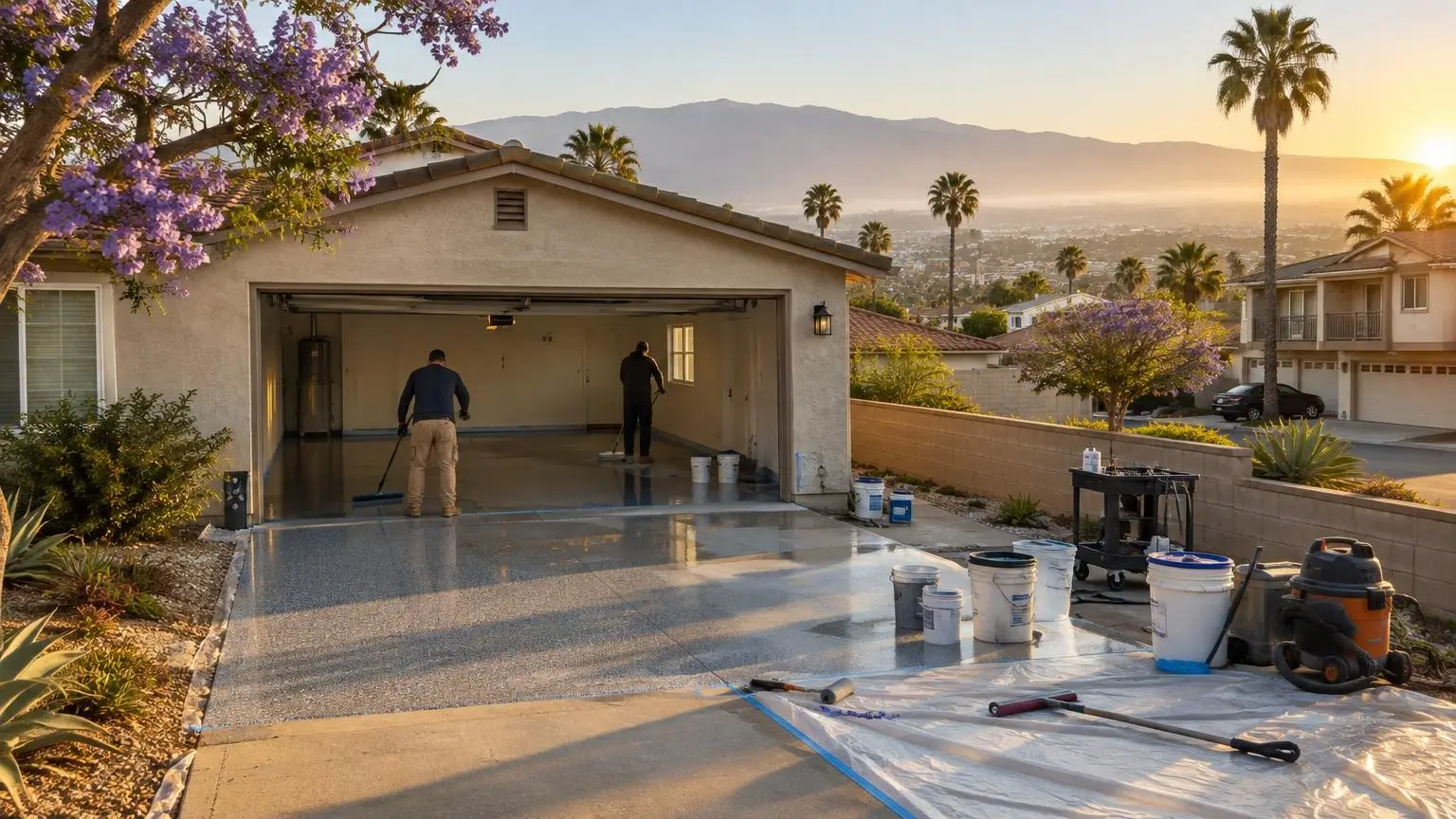
Concrete Coatings Built Around How Los Angeles Lives
Los Angeles Epoxy Flooring Pros installs epoxy flooring in Los Angeles, CA and the cities that surround it. Garage floors make up the bulk of what we coat, along with patios, pool decks, interior slabs, workshops and commercial floors. An epoxy floor coating seals bare concrete so oil, dust, water and spills stay on top, where you can sweep or mop them off, instead of soaking in. Done right, it also gives a tired slab a clean, even color. Done wrong, it peels in the tire paths within a year. The difference is almost always in the prep and in choosing a system that suits the floor and the weather, and both of those change a lot across this city.
One city, several climates
Los Angeles stretches from the Pacific across the Basin and over the Santa Monica Mountains into the San Fernando Valley, and the weather changes with it. Wikipedia's Los Angeles article gives an average July high of about 70 degrees at the Santa Monica Pier and about 95 degrees in Canoga Park, only 15 miles away. Near the coast the air stays damp: average relative humidity at LAX runs 70.8 percent for the year and 76.6 percent in July and August. Late spring and early summer bring the gray, foggy mornings people call June Gloom. For a coating crew, that means a Westside or South Bay job often waits for the slab to warm and the morning moisture to burn off before the first coat, while a Valley job starts early to beat the afternoon heat. We read the temperature, humidity and dew point at the slab before each coat, not the forecast for downtown.
Sun and heat on garage floors
Downtown Los Angeles logs about 3,254 hours of sunshine a year, and plenty of garages here keep the door rolled up for much of the day. Ordinary epoxy handles that poorly. In HomeGuide's comparison, epoxy scores only poor to fair for UV resistance while polyaspartic scores excellent, so we put a UV-stable topcoat on any floor that sunlight can reach. Heat is the second challenge. Wikipedia says heat waves are common in September and October, and the city's official record, 121 degrees, was reached at Pierce College in Woodland Hills on September 6, 2020. Tires that come in hot off summer asphalt can soften a thin coating and peel it up. A thicker system bonded to ground concrete stops that, and on very hot days we start early, since resin sets faster as the slab warms.
Earthquake cracks and older slabs
The San Andreas fault system runs through the region, and the 1994 Northridge earthquake (magnitude 6.7) caused about $12.5 billion in damage. Add the shrinkage cracks every slab develops with age and most Los Angeles garages have some cracking. Much of the Valley was built out in the postwar boom of the 1950s and 1960s, so many slabs we see are well past middle age, with layers of paint, patches and oil. Before we quote, we look at each crack. A hairline crack that has not moved gets ground open and filled so it disappears under the coating. A crack where one edge has lifted above the other, or one that opens again after repair, means the slab is moving, and a coating cannot hold over it. You hear that from us before any quote, so you can get it evaluated first. We also keep control joints in mind: some we fill, and some we leave as working joints so the slab can move without tearing the coating.
Moisture under a dry-looking slab
Downtown Los Angeles averages about 14.7 inches of rain a year, nearly all of it between November and March, and summers usually stay dry. Even so, a garage slab that looks dry for months can be drawing moisture up from the soil, especially beside a planter bed or a sprinkler line on the far side of the wall. Vapor rising through concrete ranks among the top causes of blistered, lifting coatings. We take a moisture reading during the estimate. When it comes back high, we switch to a primer formulated for damp concrete or let you know the slab has to dry before coating.
Epoxy flooring cost in Los Angeles
Published national guides offer a reasonable starting point. According to HomeGuide, installed epoxy runs $4 to $10 per square foot, so a two-car garage typically lands around $1,600 to $5,800, and polyaspartic runs $5 to $12 per square foot. Stripping an older coating, repairing cracks, choosing flake or metallic, and the overall slab size all push the number. We never quote a floor by phone. We measure, test, and hand you a written estimate, and that estimate is your price.
What to ask epoxy flooring contractors
Whether you call us or other epoxy flooring companies, these questions sort out a floor that lasts from one that peels:
- How will you prep the floor? Diamond grinding opens the surface and removes old sealer and oil. Acid etching alone often leaves both behind.
- Is the slab checked for moisture before you coat? Ask what the test is and what happens if it fails.
- What topcoat goes over the color? In a sunny garage or outdoors, it should be UV-stable.
- How many coats, and how thick? HomeGuide notes epoxy goes on at roughly 10 to 20 mils per coat and polyaspartic at 2 to 6 mils per coat, so the full system matters more than the product name.
- What happens to the cracks and joints?
- When can I walk on it, and when can I park?
- Is all of that in the written quote?
Good epoxy floor installers answer those without hedging. We put every answer in writing.
What Los Angeles garages hold
Garages here are rarely just for parking. We coat garages used as home gyms, workshops, laundry areas, storage for bikes and surf gear, and rooms for a second fridge. Wikipedia puts owner-occupied units at 36.3 percent of the city's housing, so a lot of people here rent or share a building. If that is you, check with your landlord, condo board or HOA before the install. We can give them the product sheets, colors and schedule in writing. Whatever the room is used for, we will match the finish to it: flake for hiding dust and adding grip, solid color for a clean workspace, metallic for a showpiece room, or a full polyaspartic system when you want the floor back in service quickly.
Why Homeowners Call Los Angeles Epoxy Flooring Pros
We test before we quote
Each estimate comes with a moisture reading and an inspection of cracks, old coatings and oil, so your quote matches the real slab.
Grinding, not just etching
Diamond grinding takes the floor down to clean, porous concrete, so the first coat grips the slab itself rather than old sealer or dust.
Coats timed to the weather
Ahead of every coat we read slab temperature, humidity and dew point, which counts on damp coastal mornings and hot Valley afternoons.
Everything in writing
Your written quote lists the system, every coat, the prep, crack repair and the total. Any change gets written up and waits for your OK.
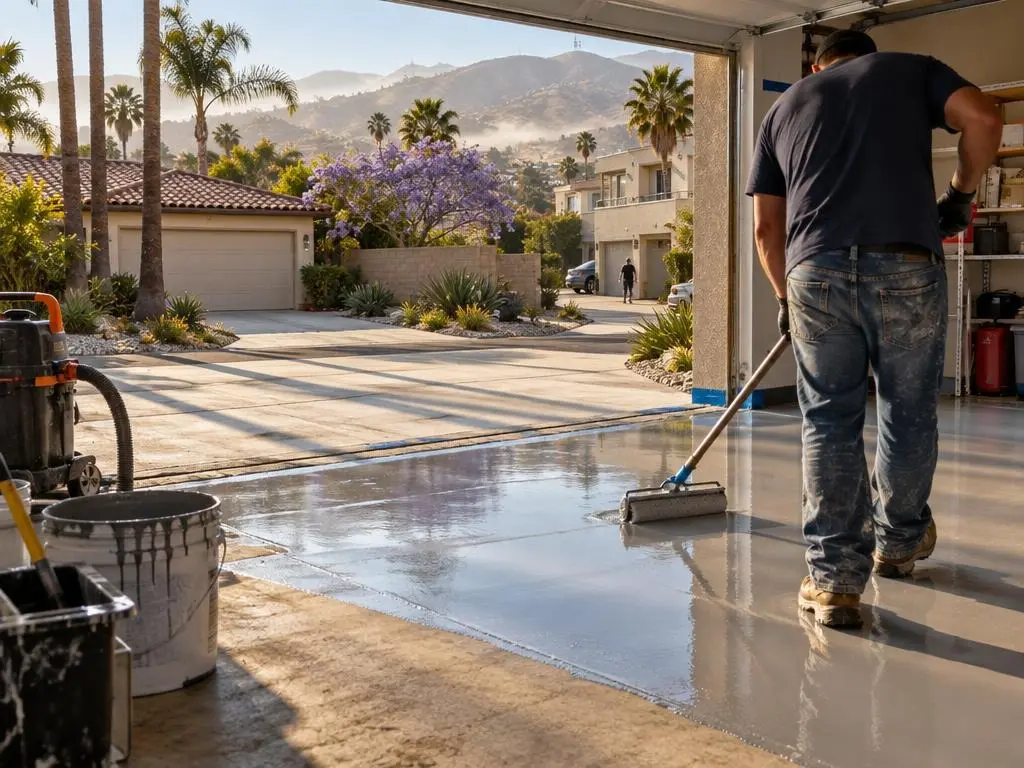
Cities and Neighborhoods We Cover
We work across the City of Los Angeles, from the Westside (Westwood, Century City, Sawtelle, Venice) and the Harbor area around San Pedro to South Los Angeles and the San Fernando Valley neighborhoods of Woodland Hills, Canoga Park, Encino and Tarzana. We also coat floors in nearby cities, including Pasadena, Glendale, Burbank, Santa Monica, Culver City, Beverly Hills, Inglewood, Torrance, Redondo Beach, Manhattan Beach, Long Beach, Downey, Whittier, Alhambra, Arcadia, Santa Clarita and Calabasas. Coastal jobs and Valley jobs get different scheduling and topcoat choices, so tell us where the floor is when you call.
- Epoxy Flooring in Los Angeles, CA
- Epoxy Flooring in Pasadena, CA
- Epoxy Flooring in Glendale, CA
- Epoxy Flooring in Burbank, CA
- Epoxy Flooring in Santa Monica, CA
- Epoxy Flooring in Culver City, CA
- Epoxy Flooring in Beverly Hills, CA
- Epoxy Flooring in Torrance, CA
- Epoxy Flooring in Long Beach, CA
- Epoxy Flooring in Inglewood, CA
- Epoxy Flooring in Downey, CA
- Epoxy Flooring in Whittier, CA
- Epoxy Flooring in Alhambra, CA
- Epoxy Flooring in Arcadia, CA
- Epoxy Flooring in Monrovia, CA
- Epoxy Flooring in West Covina, CA
- Epoxy Flooring in Santa Clarita, CA
- Epoxy Flooring in Calabasas, CA
- Epoxy Flooring in Redondo Beach, CA
- Epoxy Flooring in Manhattan Beach, CA
- Epoxy Flooring in Hawthorne, CA
- Epoxy Flooring in Carson, CA
- Epoxy Flooring in Gardena, CA
- Epoxy Flooring in Lakewood, CA
- Epoxy Flooring in South Gate, CA
Our Epoxy Flooring Services
Six coating systems for Los Angeles concrete, from sunny garages and pool decks to interior rooms and busy commercial floors.
Epoxy Garage Floors
A ground, crack-repaired and sealed garage floor finished with a topcoat built to resist hot tires and sun through an open door.
Learn more →Flake Floor Coatings
Vinyl chip floors that hide dust, tire marks and small flaws, with grip built into the surface.
Learn more →Polyaspartic Floors
A fast-curing, UV-stable coating system that can be walked on in hours and parked on in about a day.
Learn more →Metallic Epoxy
Poured, hand-worked epoxy with metallic pigments for a one-of-a-kind floor in a living space, studio or shop.
Learn more →Commercial & Industrial Epoxy
Durable concrete floor coatings for warehouses, auto shops, studios, kitchens and other working floors, scheduled around your business.
Learn more →Patio & Pool Deck Coatings
Textured, UV-stable coatings and pool deck resurfacing for outdoor concrete that lives in the Southern California sun.
Learn more →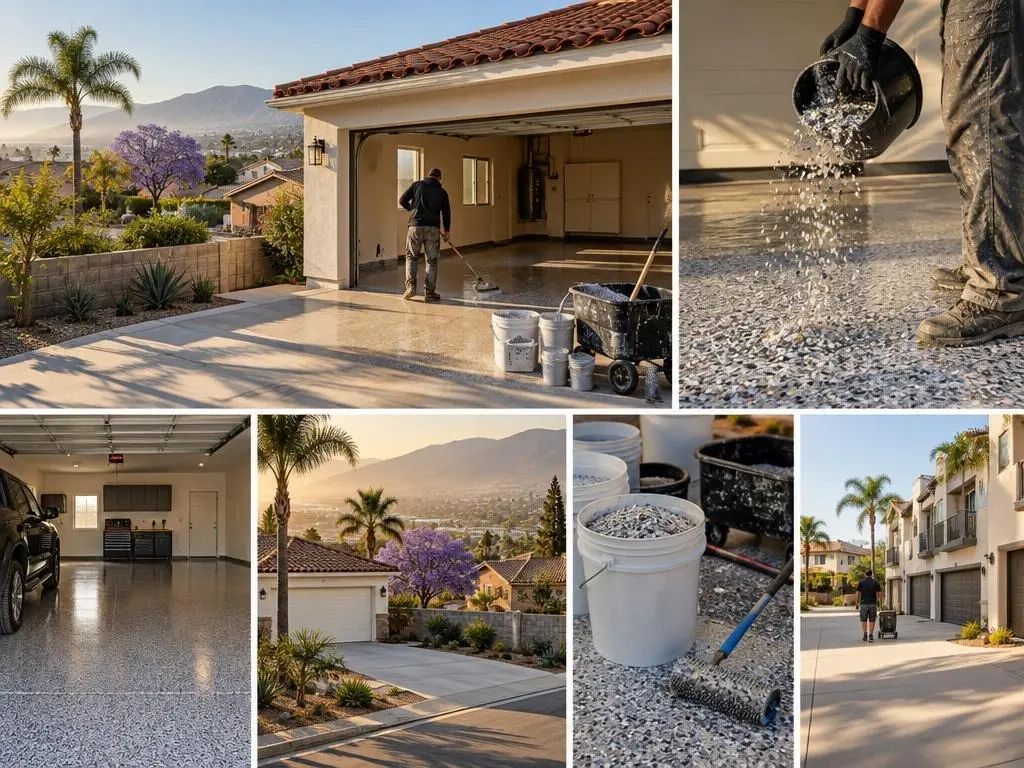
Common Questions
What should I budget for an epoxy floor?
Going by HomeGuide's national numbers, installed epoxy costs $4 to $10 per square foot, or roughly $1,600 to $5,800 for a typical two-car garage. Polyaspartic comes in around $5 to $12 per square foot. Old coating removal, crack repair and flake or metallic finishes all shift the total, so each floor is priced once we have measured and tested it. The written estimate you receive is the price.
Does epoxy flooring have drawbacks?
Standard epoxy yellows and chalks in sunlight, it takes days to cure before you can park on it, and it only lasts if the concrete was prepped and tested first. It can also be slippery when wet unless it has flake or an anti-slip additive. We handle those by grinding the floor, testing for moisture, adding grip where needed and using a UV-stable topcoat wherever the sun reaches.
What is a better floor coating than epoxy?
That depends on the floor. For garages and outdoor concrete, polyaspartic is the common step up, since HomeGuide gives it an excellent UV rating and it cures in one to two days. On many garages we pair an epoxy base, which builds thickness and bonds well, with a polyaspartic topcoat that handles sun and wear. Heavy commercial floors often call for a thicker 100 percent solids system.
Can you coat a garage floor with earthquake cracks?
Usually, yes. Static hairline and shrinkage cracks are ground open and filled before the first coat. If one side of a crack sits higher than the other or it keeps reopening, the slab is moving, and we will advise having it checked before you pay for a coating.
How soon can I park on a new floor?
HomeGuide says to keep cars off a new epoxy floor for 2 to 7 days, while polyaspartic is usually ready for vehicles in about 24 to 48 hours. Heat, humidity and the exact product change that, so we give you a walk-on time and a park-on time for your floor on install day.
Does the coast or the Valley change what you install?
Yes. Near the coast, morning humidity and the marine layer can delay coats until the slab is warm and dry enough. In the Valley, summer and fall heat shorten working time and make hot tire pickup more likely, so we start early and build a thicker, well-bonded system with a UV-stable topcoat.
I rent or live in a condo. Can I still get my garage coated?
Often, yes, with approval. Check your lease, condo rules or HOA guidelines first. We can provide product details, colors and the planned schedule in writing so your landlord or board can sign off before the install.
Schedule Your Free Los Angeles Floor Estimate
We come out, take a moisture reading and hand you a written quote. Call (213) 521-8596 or use the form.